B2B Supplier Directory for Smarter Global Lead Growth
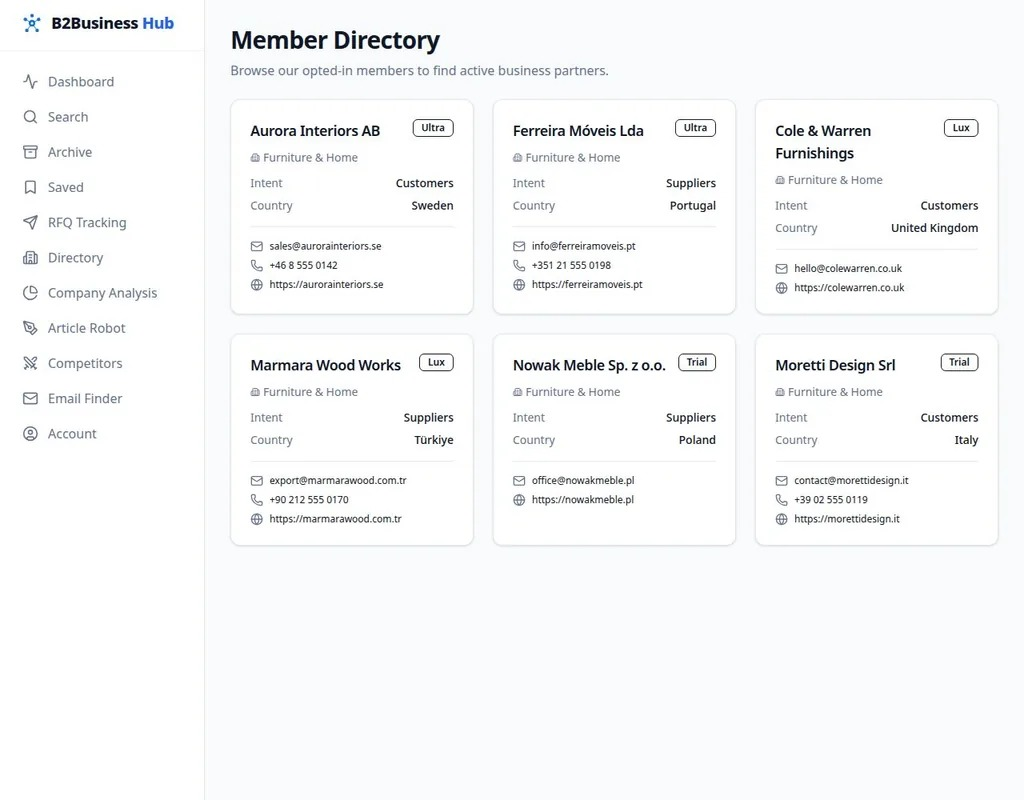
A b2b supplier directory has become an important resource for companies that want to discover reliable buyers, suppliers, manufacturers, distributors, and potential business clients across international markets. Instead of depending entirely on manual searches, referrals, or outdated databases, businesses can use an AI powered discovery platform to identify organizations that closely match their commercial requirements. Modern platforms combine business information with intelligent search technology, making it easier for sales and sourcing teams to explore opportunities efficiently. This approach can save valuable research time while giving businesses a more structured way to expand their professional networks.
The concept goes far beyond displaying a basic list of company names and industries. An AI powered B2B lead generation and business discovery platform can bring company research, contact finding, competitor analysis, trust indicators, and outreach capabilities into one accessible environment. Users can research organizations, understand their activities, identify suitable prospects, and prepare more relevant communication before making contact. For growing companies, this creates a practical connection between discovering an opportunity and turning that discovery into a meaningful business conversation.
What an AI Powered B2B Discovery Platform Does
Traditional business directories were generally designed as searchable databases where companies could browse organizations by category, product, or geographic location. Modern AI powered platforms take this concept further by organizing large amounts of business information and helping users narrow their searches according to specific commercial objectives. A company looking for manufacturers in a particular industry, for example, can focus its research on relevant businesses instead of spending hours reviewing unrelated search results. Better organization can make business discovery faster and more purposeful.
Artificial intelligence can also improve how business information is interpreted and connected. Rather than requiring users to search through countless records individually, intelligent systems can identify similarities between companies, industries, products, locations, and potential commercial relationships. This helps sales teams discover prospects while allowing sourcing professionals to research potential suppliers more efficiently. The platform therefore becomes a business intelligence resource that supports both lead generation and supply chain discovery.
Finding Buyers Suppliers and Manufacturers Worldwide
One of the strongest advantages of using a b2b supplier directory is the ability to research companies beyond a business’s immediate local market. Manufacturers may want to locate international distributors, exporters may need qualified importers, and service providers may be interested in companies operating within particular industries. A global discovery platform can organize these different business categories and make them easier to research. This creates opportunities for companies that want to enter new markets without beginning their research completely from scratch.
International business discovery can also help organizations compare potential partners across several regions before committing resources to outreach or negotiations. A company might research manufacturers in one country while simultaneously identifying distributors or buyers in another target market. Access to organized company information gives decision makers a clearer starting point for evaluating opportunities. It does not eliminate the need for due diligence, but it can significantly improve the early stages of international business research.
How Company Data Supports Better Lead Generation
Quality company data is central to effective B2B prospecting because successful outreach depends on contacting organizations that are genuinely relevant. Useful records may include company names, industries, locations, websites, business descriptions, operational details, and available professional contact information. When these details are organized properly, sales teams can create more focused prospect lists instead of sending messages to companies with little connection to their products or services. Relevance generally produces a stronger foundation for professional outreach.
Company information can also help businesses understand prospects before beginning a conversation. Knowing what an organization does, where it operates, and which market it serves makes it easier to prepare communication around realistic commercial needs. This research based approach is especially valuable when targeting decision makers who receive numerous generic sales messages. Instead of relying on volume alone, companies can focus on better prospect selection and more thoughtful engagement.
Using AI to Discover More Relevant Business Leads
Artificial intelligence can make a b2b supplier directory more useful by helping users identify companies based on relationships between industries, business activities, products, markets, and search intent. A traditional keyword search may produce broad results, while AI assisted discovery can potentially surface organizations that fit a more specific commercial profile. This is valuable when users know the type of business relationship they need but do not already have a list of company names to investigate. Intelligent filtering can reduce unnecessary research and improve prospect relevance.
AI can also support lead prioritization by helping users recognize which organizations deserve deeper research first. Instead of treating every company record equally, businesses can evaluate available signals and concentrate on prospects that appear more closely aligned with their goals. Human judgment remains essential because automated recommendations can be incomplete or inaccurate. However, combining intelligent discovery with professional review can make prospecting more efficient without removing human decision making from the process.
Contact and Email Finding for Business Outreach
Discovering the right company is only part of lead generation because businesses also need an appropriate way to establish contact. Contact and professional email finding capabilities can help sales teams identify publicly available or lawfully sourced business contact details associated with relevant organizations. This can reduce the time spent moving between company websites, search engines, professional networks, and separate research tools. Centralized contact research can therefore make the transition from discovery to outreach more manageable.
Accuracy remains important because contact information can change as employees move positions or companies update their organizational structures. Businesses should verify important details before launching significant outreach campaigns and should avoid assuming that every discovered address belongs to the correct decision maker. A carefully verified contact list is generally more useful than a much larger database filled with uncertain information. Good prospecting depends on relevance, accuracy, and respectful communication rather than simply collecting the highest possible number of email addresses.
Competitor Analysis and Market Research
Business discovery platforms can provide value beyond direct lead generation by supporting competitor and market research. Companies can examine organizations operating within similar industries, study how crowded particular markets appear, and identify businesses serving related customer segments. This research can reveal potential gaps, partnership opportunities, or areas where competition is particularly strong. It can also help companies develop a more realistic understanding of the commercial environment before entering a new region.
Competitor information should be used to support strategy rather than to copy another company’s activities. Businesses can study publicly available market signals and use them to refine positioning, targeting, product development, or outreach strategies. When company discovery and competitor research exist within the same environment, users can move from understanding a market to identifying potential opportunities within it. This makes business intelligence more actionable for sales, marketing, procurement, and management teams.
Trust Scores and Supplier Evaluation
A modern b2b supplier directory may use trust scores or similar indicators to help users evaluate companies during the initial research process. Such scores can potentially combine different data signals to provide a convenient reference point when comparing organizations. They may be particularly useful when researching unfamiliar suppliers or potential partners in overseas markets. However, a trust score should be viewed as one research signal rather than an absolute guarantee that a company is legitimate, financially stable, or suitable for a specific transaction.
Businesses should conduct independent verification before signing contracts, sending substantial payments, sharing confidential information, or entering long term commercial relationships. Depending on the transaction, this may involve confirming business registration, reviewing references, checking certifications, examining payment terms, verifying physical operations, and obtaining appropriate legal advice. Combining platform based indicators with traditional due diligence provides a more responsible approach to supplier selection. This is especially important when dealing with high value or cross border transactions.
AI Outreach Tools for More Relevant Communication
AI outreach tools can help businesses turn prospect research into personalized communication without writing every message manually. They can assist with drafting introductions, adjusting messages for different industries, summarizing company information, and creating outreach based on known business characteristics. This can be particularly helpful for sales teams managing large prospect databases. The goal should be to improve relevance and efficiency rather than produce large volumes of repetitive messages that recipients are unlikely to value.
Human review remains essential before AI generated outreach is sent. Automated systems may misunderstand a company’s services, make incorrect assumptions, or create wording that does not fit the intended relationship. Sales professionals should review messages for factual accuracy, professionalism, and genuine relevance to the recipient. AI works best as an assistant that accelerates preparation while leaving important communication decisions under human control.
Benefits for Sales Procurement and Business Development
Different departments can use business discovery technology for different objectives. Sales teams can identify prospective clients, procurement teams can investigate manufacturers and suppliers, and business development professionals can search for distributors or strategic partners. A shared research environment can reduce duplication because multiple teams do not need to build every business database independently. This can create a more consistent approach to discovering and evaluating external organizations.
Small and medium sized businesses may find these capabilities especially useful because they often have limited resources for dedicated market research. Instead of maintaining several disconnected tools for company discovery, contact research, competitor intelligence, and outreach preparation, they can use an integrated platform to support several stages of the workflow. The value ultimately depends on data quality, appropriate filtering, and how carefully teams evaluate the information before acting on it.
Legal and Regional Considerations for B2B Prospecting
Companies using a b2b supplier directory for lead generation should consider privacy, electronic marketing, and data protection requirements in the regions where they operate and contact prospects. Laws and regulations can differ significantly between countries, particularly regarding personal data processing, direct marketing, email communication, consent, legitimate interests, disclosure requirements, and recipients’ rights to object. Businesses operating internationally should establish compliance procedures appropriate to their target jurisdictions rather than assuming that one outreach method is acceptable everywhere.
Organizations should pay particular attention to applicable rules such as the European Union’s GDPR and ePrivacy framework, the United Kingdom’s data protection and electronic communications requirements, and relevant national anti spam or privacy legislation elsewhere. Regulations and their interpretation can change, so businesses conducting substantial campaigns should obtain current guidance from qualified legal or compliance professionals. Maintaining transparent data practices, honoring opt out requests, and avoiding deceptive communication can also contribute to more responsible business outreach.
How Businesses Can Improve Their Lead Research
Effective lead generation begins with a clear understanding of the ideal customer or business partner. Before searching a platform, companies should define relevant industries, geographic markets, organization types, product categories, and other characteristics that influence commercial suitability. A narrower profile can produce a more useful prospect pool than a broad search for thousands of unrelated companies. Teams can then review the most promising organizations individually and verify important information before initiating communication.
Businesses should also treat lead research as an ongoing process rather than a one time activity. Markets change, companies expand into new regions, contacts move to different positions, and potential suppliers introduce new capabilities. Regularly reviewing prospect information helps keep outreach strategies aligned with current conditions. Combining structured research with personalized communication can ultimately create stronger opportunities than relying on automated prospect collection alone.
Building Better International Business Opportunities
Global business development requires both access to information and the ability to interpret that information correctly. A discovery platform can shorten the distance between a company and potential partners by organizing business data into a searchable environment. However, meaningful opportunities still depend on understanding market needs, researching prospects carefully, and presenting a relevant commercial proposition. Technology can accelerate discovery, but successful relationships are built through credibility and mutual value.
Companies expanding internationally should also recognize differences in language, business culture, purchasing behavior, regulations, payment practices, and negotiation expectations. Researching these factors before contacting prospects can improve communication and reduce avoidable misunderstandings. When global company discovery is combined with local market awareness, businesses are better positioned to approach potential buyers, suppliers, manufacturers, and distributors with realistic expectations.
Choosing a Reliable B2B Discovery Platform
Businesses evaluating a discovery platform should consider the quality and usefulness of its company information rather than judging it only by the size of its database. Relevant search capabilities, current records, transparent information, contact research features, competitor insights, and practical AI tools can all influence the value users receive. The best solution is one that supports the actual workflow of discovering, researching, evaluating, and contacting appropriate organizations without creating unnecessary complexity.
Companies should also understand where business information comes from and how frequently important records are reviewed or updated. No database can guarantee that every company or contact detail will remain accurate indefinitely, so users should maintain reasonable verification practices. Platforms that help users narrow large markets into manageable groups of relevant prospects can still provide significant value, particularly when combined with careful human research and responsible outreach.
Conclusion
An AI powered business discovery platform can transform the way organizations approach lead generation, supplier research, competitor analysis, and international business development. By bringing company information, contact discovery, trust indicators, research capabilities, and outreach assistance together, it can reduce the amount of manual work required to identify promising commercial opportunities. Businesses can spend less time searching through scattered information and more time evaluating the prospects most likely to fit their objectives.
The greatest results come from combining intelligent technology with responsible human decision making. Companies should verify important information, follow applicable privacy and marketing regulations, personalize communication, and conduct appropriate due diligence before entering significant business relationships. Used carefully, B2B discovery technology can help sales, procurement, and business development teams build stronger prospect pipelines and explore new markets with greater efficiency and confidence.


Post Comment